PTEROSTYLIS (Greenhoods)
Other common names are Shell, Snail, Midget, Jug, Cockatoo, Banded, Dwarf. The genus is widespread throughout Australia and most abundant in the southern areas. Their underground vegetative reproduction produces masses of over lapping leaf rosettes, which are mostly immature plants of which about 10%, flower each year. The flowering plants do not produce rosettes but have varying sized and numbers of cauline leaves. The highly successful pollinating strategy produces copious seeds that germinate readily and produce large numbers of plants. Darwin, in his classic work "The Fertilisation of Orchids", stated that Pterostylis had evolved the most amazing and effective reproduction strategy within the world's Orchidaceae. The first research relating to these strategies was undertaken by Cheeseman in 1833 in New Zealand and this was followed by Fitzgerald 1882; Edith Coleman in the Eastern States and Sargent in 1907 in WA. All were able to define the remarkable mechanism of the sensitive labellum that was able to trap visiting insects. The insects enter the galea (pouch) and probe the base of the pouch for a liquid they find irresistible. This activates the sensitive labellum, which with the assistance of the column and the column wings forces, the insect backwards and traps it in a confined space. The margins of the column are coated in coarse hairs and notches ensuring that the only way out is upwards. The column wings channel the insect to the sticky stigma and the two pollen sacks. A daub of this sticky glue fastens the pollinia to the insect and they are then transported to the next flower. The insect attracting agent is a sublime secretion at the base of the pouch and some researchers have postulated that the insects receive a drink/food with possible sexual attractions. The galea encloses the winged column and sensitive labellum where the dorsal sepals and petals and the lateral sepals unite to form the pouch. The labellum, broadly elliptical, has hairs and indentations along both sides giving footholds to enable the insect to escape upwards. It is held forward below the sinus (the union of the lateral sepals) by an elastic claw at the base. Insects entering trigger off the sensitive labellum that forces the visitor to a confined space where the only escape is upwards so that the pollinating process described earlier is effected. If pollination has not been effected then the labellum retracts ready to repeat the process. This takes from 20 minutes to some hours depending on the ambient temperature. The precise explanation of just how the elastic claw performs its purpose is still subject to scientific research. However the mechanism seems to be highly efficient as almost all flowers produce seed capsules.
Bird orchids. This distinctive group is present in most of the lower southwest with only a few outside this area. The actual number of species is not known but this should be rectified when the current revision is published. The species name' barbata' refers to the hairy bearded labellum that is characteristic. The labellum is thin, wiry and has mostly coarse irregular hairs that serve to close off the orifice containing the stigma and pollinias. The same sensitive elastic hinge, as for the entire genus, is employed.
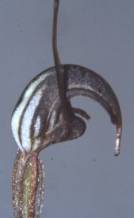
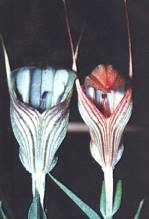
|
Pterostylis allantoidea,
Ravensthorpe, Sep 1987 |
Pterostylis aspera, Pterostylis
rogersii, Ledge
Beach, Albany |
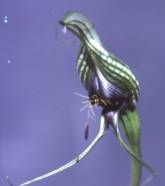
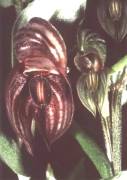
|
Pterostylis barbata, �Manjimup, Sep 1981 |
Pterostylis concava, Pterostylis
vittata |
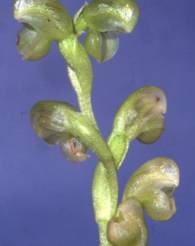
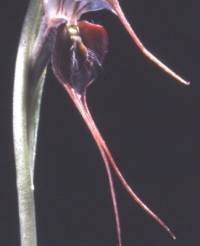
|
Pterostylis cycnocephala,
Northampton, Aug 1992 |
Pterostylis despectans, Hyden,
Aug 1975 |
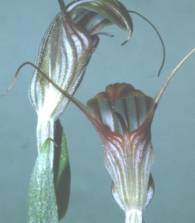
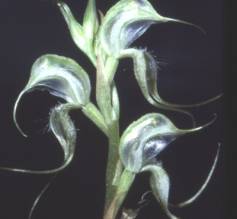
|
Pterostylis hamiltonii, Wagin,
Aug 1988 |
Pterostylis leptochila,
Pallinup, Nov 1984 |
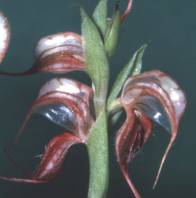
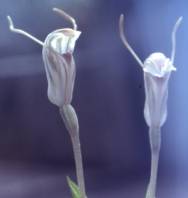
|
Pterostylis macrocalymma, Murray
Bridge, Sep 1994 |
Pterostylis nana, Katanning, Sep 1979 |
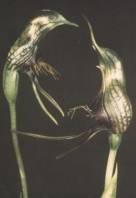
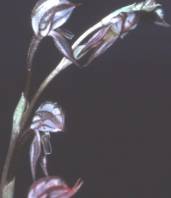
|
Pterostylis plumosa, Hyden, Pterostylis
barbata,
Pemberton |
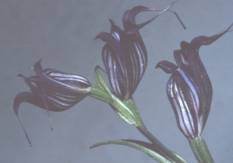
Pterostylis pusilla, Boxwood
Hills, Oct 1982 |
|
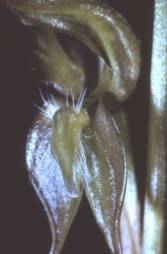
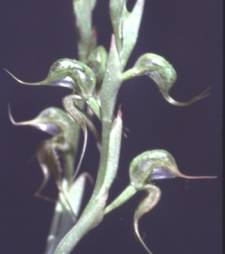
Pterostylis recurva, Wagin,
Sep 1990 |
|
Pterostylis roensis,
Jerramungup, Oct 1976 |
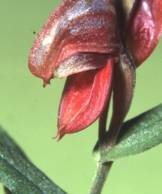
Pterostylis rufa, Boyup Brook, Nov 1980 |
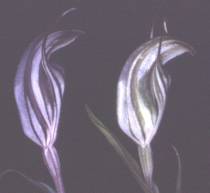
|
Pterostylis sanguinea, Billercay, Sep 1995 |
Pterostylis scabra, Aug
1980 |
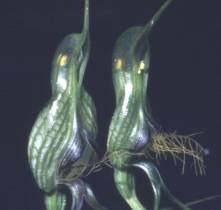
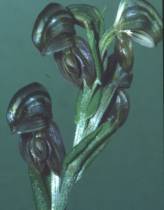
|
Pterostylis barbata, Pterostylis
turfosa,
Bullcreek, Perth, Sep 1986 |
Pterostylis vittata, Wagin,
Aug 1988 |
PYRORCHIS (Beak orchids)
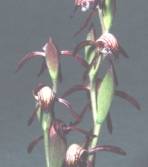
The genus includes 2 species
previously classified as Lyperanthus (Hoffman and Brown, 1998). Both
species have a fleshy, oval leaf, live in colonies and flower following hot
summer bushfires. Pyrorchis nigricans also occurs in South Australia,
Victoria, New South Wales and Tasmania.
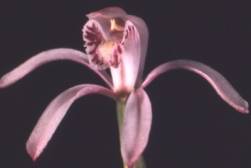
|
Pyrorchis forrestii, Nov
1974 |
Pyrorchis nigricans,
Denbarker, Oct 1988 |
RHIZANTHELLA (Underground orchids)
In 1928, Farmer John Trott of
Corrigin, unearthed the first specimens of Rhizenthella gardneri when
ploughing new land that had been previously rolled and burnt. He took the
specimen to Charles Gardner, the Government Botanist, who, in turn, forwarded
them onto Dr. Sanders Rodgers who named the species in Gardners honour. As the
common name implies, the species spends most of its life cycle underground,
growing in association with, and close to Melaleuca uncinata, that sheds
its leaves to produce thick layers of leaf mould. The developing capitulum of
tiny, crowded orchids, are exposed when the floral bracts expand and,
occasionally push through the leaf mould, allowing light, and presumably
pollinators to enter. Since the first finds, just six confirmed sightings were
made in Corrigin - Babakin areas. A breakthrough occurred in 1979 when farmer
John McGuiness of Munglinup, East of Ravensthorpe, turned over a Malley root
and found an orchid under it. Research then and again in 1980 produced a total
of 26 specimens. Further collections were made at the Oldfield locations, with
another 9 plants sighted . Finance was made available for research from the
World Wildlife Fund, resulting in a well organized research program led by
Kings Park research scientists and assisted by the members of the Western
Australian Native Orchid Study Group. Around 150 sightings were made and as a
result of this and ongoing research, the knowledge of the biology of Rhizanthella
gardneri has been greatly advanced. Rhizanthella gardneri are
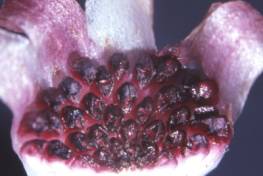
unusual in other ways amongst the orchid family. The flowers are produced in a
capitulum, which appears to be one large flower but on closer examination,
proves to be a whole group of small flowers grouped together within a series of
bracts which gives the appearance of being a single flower.
Ron Heberle
|
Rhizanthella gardneri,
Corrigin, May 1982 |
SPICULAEA� (Elbow orchid)
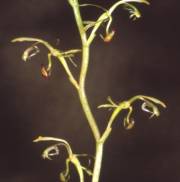
Spiculaea (spiked
column wings) ciliata (soft hairs on the labellum).This remarkable
orchid is the product of a much harsher environment than that of the present.
It has adapted to survive, flower and reproduce in the summer months (November
to January) when all surface moisture is absent. It is widely distributed
inland to the goldfields and west to the Darling Scarp where it grows in thin
layers of moss and soil on and around granite sheets of rock.To withstand the
environmental hazards, the leaf and stem dry off from the base upward to force
the sap up the succulent stem enabling the buds to open in turn. This survival
trait is demonstrated well when a plant can be plucked, placed in a letter and
sent by post without any protection half way across the world to the USA or to
Europe, and when received the buds will continue to open. The pollinating
strategy is similar to that of the Drakaea where the insect imitating
labellum is attached to a wiry stem hinged in the centre. Although not
sensitive it can only move in the direction of the column (as with Drakaea)
and achieves pollination via pseudo-copulation. The male wasps, attempting to
carry off the sham female, are carried forward and guided by the spiked column
wings either to transfer pollen to the stigma or to be daubed with pollen to be
carried to another plant. A� truly
remarkable orchid. Ron Heberle April 2003
|
Spiculaea ciliata, Moirs
Rock, Oct 1978 |
THELYMITRA (Sun orchids)
Thelymitra's are a terrestrial orchid genus found in Australia, (50 odd species) New Zealand, (about a dozen species) New Caledonia, (2) and the odd one in Timor, Java, and The Philippines.
The Thelymitra's on the following pages, all come from the
south west of Western Australia, specifically, the area around Albany, which is
known for it's unusual flora. Thelymitra's are known as 'Sun Orchids' because
of their tendency to only open on sunny days, closing at night and during cold
and cloudy weather.
Unlike most orchids, the lip, or what passes for a lip, is usually the same
shape as the petals. There are, however, a few species in which the lip tends
to be modified slightly, and appears to be shaped like a 'normal' orchid
lip.�
One of the most outstanding features of Thelymitra's, is the huge colour range,
which can include white, yellow, pink, red, orange, blue, purple and all sorts
of combinations of the above, which can produce orchids that are quite stunning,
as Ron Heberle's photographs will show. The blue Thelymitra's can be quite
unbelievable when one comes across them in the bush, as true blue orchids are
so rare in nature. The number of flowers carried on Thelymitra's, varies
between one and 20 to 25, sometimes more. Flower size is between 1 - 6cm.
Ron Heberle