RON HEBERLE
ORCHID
PHOTOS
Western
Australia
Ron Heberle
Greg Heberle
Graham Bowden
Tony Watkinson
�Ron Heberle orchid photos Western
Australia� by Ron Heberle, Greg Heberle, Graham Bowden, Tony Watkinson.
Submitted to publisher May 2006.
All rights reserved. No part
of this publication may be produced,
stored in a retrieval system
or transmitted in any form or by any means,
electronic, mechanical,
photocopying, recording or otherwise
without the permission of the
copyright owner.
� Greg Heberle, 2006
Published by Ocean Publishing
Printed and bound in Western
Australia
ISBN 1920783 52 0
CONTENTS
Cover photos:
Top left to right:
Diuris amplissima, Kojonup,
Nov 1989
Thelymitra nuda, Mt
Barker, Nov 1988
Caladenia flava Pink,
Albany, Oct 1988
Bottom left to right:
Possible hybrid Caladenia
radialis x Caladenia roei, Wedin, Sep 1994
Pterostylis rufa, Murray
Bridge, Sep 1994
Cyanicula gemmata, Mt
Clarence, Albany, Oct 1988
|
|
Page |
|
Introduction |
4 |
|
Ron Heberle by Graham Bowden |
4 |
|
An afternoon with Ron Heberle. An interview by Tony
Watkinson. |
5 |
|
The passing of legends by Graham Bowden and Tony Watkinson |
12 |
|
Caladenia (Spider orchids) |
16 |
|
Calochilus (Beautiful lip or Beard orchids) |
40 |
|
Corybas (Helmet orchids) |
41 |
|
Cryptostylis (Slipper orchids) |
42 |
|
Cyanicula (Blue orchids) |
43 |
|
Cyrtostylis (Mosquito orchids) |
45 |
|
Diuris (Donkey orchids) |
47 |
|
Drakaea (Hammer orchids) |
51 |
|
Drakonorchis (Dragon orchids) |
53 |
|
Elythranthera (Enamel orchids) |
54 |
|
Epiblema (Babe in a cradle orchids) |
56 |
|
Eriochilus (Woolly lip or bunny orchids) |
57 |
|
Gastrodia (Potato orchids) |
58 |
|
Genoplesium (Pygmy orchids) |
58 |
|
Leporella (Hare orchid) |
59 |
|
Leptoceras (Rabbit orchid) |
59 |
|
Lyperanthus (Rattle beaks) |
60 |
|
Microtis (Mignonette orchids) |
61 |
|
Monadenia (South African orchids) |
62 |
|
Paracaleana (Duck orchids) |
63 |
|
Praecoxanthus (Leafless orchid) |
63 |
|
Prasophyllum (Leek orchids) |
64 |
|
Pterostylis (Greenhoods) |
67 |
|
Pyrorchis (Beak orchids) |
72 |
|
Rhizanthella (Underground orchids) |
72 |
|
Spiculaea (Elbow orchids) |
73 |
|
Thelymitra (Sun orchids) |
74 |
|
Ron Heberle orchid papers |
84 |
|
References |
84 |
|
Index |
85 |
INTRODUCTION
Ron Heberle photographed orchids
from about 1975 until shortly before his death in 2004. After he died, his
collection of photographic slides passed into my care. About 95% of his slides
were of native orchids from Western Australia. The orchid slide collection
contains over 1870 slides, including over 50 by others, mainly H Foote and D
Voigt. Some 95% of the slides have details such as his interpretation of the
name of the orchid, place of collection and date. Slides with no details have
been left out of this book. Generally only scientific names appear on the
slides and a similar approach has been followed in this book. Unfortunately
some of the details on the slides are abbreviated, incomplete, or illegible.
The available details are listed for each photograph included in this book. The
collection probably includes slides of over 90% of the State�s native orchids.
Generally the names on the slides are as at time of photography, so that few
have names revised in the past 10 years or so. This book generally has the
orchid names as shown on the slides and on the Species Orchid Society Internet
site, even though many are superseded and some could be wrong. A quick check of
the names on the slides compared to Hopper and Brown 1984 and 1998, suggests
that the former is often followed. For a few orchids, older names have been
used, including some from Erickson 1951. Obvious spelling errors have been
corrected. Many of the slides depict possible hybrids, often with the likely
parent species. Generally the possible hybrid is in the middle, with the likely
parent species on either side.
Most of Ron Heberle�s slides are
available on the Species Orchid Society website:
http://members.iinet.net.au/%7Eemntee/page18.html
Some of his slides are available
via Greg Heberle�s website:
http://freepages.genealogy.rootsweb.com/~gregheberle/
This book includes over 250 of Ron
Heberle�s orchid photos, some introductory notes for each genus and 3 articles
covering Ron Heberle, from the Species Orchid Society website.
Further details of Ron Heberle�s
life are presented in 2 books: �Heberle family 1500-2005� and �Heberle fishing
Western Australia 1929-2004�, see References.
Greg Heberle.
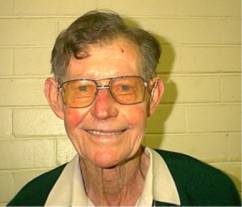
RON HEBERLE
Ron was born on Christmas Eve 1913
in Perth WA. He grew up in the city being educated at the Victoria Park Primary
School and the Thomas Street Secondary School. At the age of 17 he went, with
his brother, to Kalgoorlie to work on a diamond drilling crew. It was during
holidays in Esperance that they befriended a fisherman and found catching and
selling fish door to door quite lucrative. So much so that his father left his
Perth job and joined the boys. They spent a couple of days fishing and then
sold their catches through Ravensthorpe, Lake King and as far away as Wagin.
Good advice finally saw them settle their business in Katanning (1936). Ron
joined the RAAF in WW2 and was sent to England as a pilot. He returned and in
1946 married Pauline.
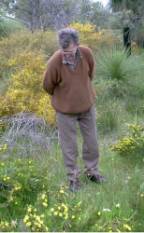
The Heberles fished the fairly
remote areas along the South coast from Esperance to the west of Albany and
travelled through long stretches of undisturbed bush. Ron's love and knowledge
of native flora was nurtured by his mother (she had a wonderful collection of pressed
flowers) and his travels had him in contact with such beautiful plants as the
Royal Hakea. When his father retired Ron and his family moved to Albany and it
was the flower shows for his children's school (Spencer Park Primary) which had
them all searching and collecting orchids. With the headmaster, Ron Oliver,
Ron, Pauline and their children increased their interest in the terrestrial
orchids around the Albany area. Ron learnt photography with the help of friends
and family. He preferred colour slides as he found they gave him truer colours
and it was easy for him to share his joy and photos with other orchid lovers.
Ron has published regularly in The Orchadian, has orchids named after him, is a
member of the AOF and is a valued confidant and supplier of materials to orchid
people in Australia, Europe and the USA. He has an extensive knowledge of the
geography of the south west of WA and the precise location of many orchid
species. His interest in natural hybrids and variations within species has been
beautifully recorded in his 1500 plus slides. These slides are to be donated to
the National Herbarium in Canberra. Ron likes to point out that these slides
only represent a fraction of his experiences with the wonderful WA terrestrial
orchids. Ron and Pauline recently moved to Perth and joined our Orchid Species
Society of WA. He wishes to make his records available to as many people as
possible and this is why he has invited our society to put samples of his
photography on our Internet site. ENJOY!
Graham Bowden 2002.
AN AFTERNOON WITH RON HEBERLE
The Species Orchid Society of
Western Australia (Inc)
Ron Heberles Thelymitras
(An interview by Tony Watkinson)
(RH) When you see Thelymitra
flowering it's often after a fire the previous summer. The fire must do
something to the soil, or maybe it regenerates dormant mycorrhizal fungi, I
don't know. A lot of people have got theories, but as far as I know the
mechanism is not yet known.
This theory business dominates
everything to do with nature, and what people try to do is bend nature to suit
their theories. You can't do this. You can publish papers and if people swallow
it, fair enough, but nature has a habit of making a fool of you.
As a guest speaker at the 1991 AOC
conference I covered Thelymitra the full story as I saw it from my experience,
plus bits and snips from other people.
Thelymitras are fantastic orchids
and they are so aesthetically attractive. People are absolutely staggered when
they see them. Not many people know much about these orchids.
(TW) I am still getting some great comments from people who have seen the web
site.
(RH) Yes. I'm delighted about that. In regard to future directions, I would
like to see as many of my slides put on the web site as can be done. I realize
that this is a lot of work for you.
(TW) Well, yes, but it's just a matter of putting your head down and doing it.
(RH) If they want slides, I can
supply them, but they cost to get copied, and you have to pay postage and that
sort of thing. But my main interest is to see that people get to see them. I
don't want to make any profit out of it at all.
When they had the World Orchid Conservation Conference here in Perth in 2001,
they approached me about ideas for putting the terrestrials in the exhibition
hall. I said yes, I had about 100 prints and I could get some more made to
exhibit. There were about 400 of them and they were an absolute sensation. Most
of the locals had never seen some of them, never mind the visitors.
(TW) Unless you are wandering about the bush, you wouldn't see them.
(RH) No. And you've really got to know your way around in the bush, they are
not very co-operative, they are cunning little devils, they don't make things
easy for we humans, all they are interested in is perpetuating the species.
When it comes to Caladenias, you need to be more selective because there are a
lot of Caladenias that are not aesthetically attractive. They are uniquely
different, but they are not any where near as colorful as the Thelymitras. Some
are very attractive but others are not, so you have to say, well, all right,
what am I going to do, just entertain people or am I going to produce something
that's got a bit of meat to it. From my point of view, that's my approach. If
people just want to look at them, then that's OK, but I want to produce
something that makes people think, makes them get off their tails and do
something.
TW) When did you first become
interested in orchids?
(RH) Well, my mother was mad about general flora when we were kids in Perth,
and the whole area where we lived was bush and covered in wildflowers. You
could walk from Claremont up to North Beach and there wasn't a house or
anything. At North Beach there was a pub, a couple of stores and two or three
houses. There wasn't anything in between at all. And it was a tremendous patch
of bush and orchids too. Kids are fascinated by orchids. I mean wildflowers
don't bother them much, they are pretty naff, but orchids, they've got
something that's entirely different, and kids get fascinated as my sisters and
I were. And when we grew up and went to school, if you mentioned that you were
interested in all that, they gave you the treatment so we sort of, dropped out
of it. But when Pauline and I got married. She was a country girl, lived on a
farm at Geeralying and there were orchids everywhere. We were living in
Katanning and I, along with five other people, started a naturalists club. The
bulk of the members were farming people and in those days, every farm had a
patch of bush on it. So we used to have a couple of wildflower shows, and
natural history shows every year. The farmers would bring in buckets of Donkey
Orchids and White Spider Orchids. I volunteered, with Pauline's help with our
kids, to be responsible for the orchids. We just picked what we needed for the
shows; about three specimens of every one. From that time on we sort of
concentrated on orchids. When we went to live in Albany, we were fortunate that
the headmaster of our kid's school was also wrapped in orchids. Albany is a
marvelous area for orchids. There are more orchids within 200 km of Albany than
anywhere else in the state. We got involved with the wildflower society and we
did the same thing there as in Katanning. We took over responsibility for
collecting and displaying the orchid section, and as such, we were invited to
do something similar in other country towns. So we built up an interest on the
basis of learning something about them, not just finding them. That's been very
difficult but after 40 years, I've got a few clues. The problem with orchids,
as I've mentioned, is that they are cunning little devils, diabolically
cunning. You think you know something about them and then you are confronted
with irrevocable evidence that you were wrong. This goes on all the time, so
you keep having to change your ideas, but eventually, you come to the
inescapable conclusion that you've got to accept that the varieties are
infinite. There's neither a beginning nor an end to them. Some professionals
like to put them into tidy little boxes called genera and species. They won't
stop in those boxes; many jump straight out of them. Once a professional
publishes something and has it validated, under the international code, we are
all expected to follow it. Well, I do a bit of that, but I query them. I write and
publish papers representing different points of view. Well, I'm sometimes not
very popular for that. Some don't like amateurs they consider are encroaching
on their preserves. Some taxonomists change the genera and species and are
going overboard by splitting up genera, and this has made it very difficult.
These revisions, if anything, are supposed to make things clearer, instead of
that, they make a highly complex business more complicated. Anyway, that's
another story.
(TW) When did you start taking Photographs of orchids?
(RH) In the mid seventies. I was invited to become a collector for the State
Herbarium. It was pretty difficult to get specimens to Perth, and I didn't know
what they wanted, so I thought that if I photograph them, they could have a
look at the slides, and if they want them, I can go and get the specimens for
them. Well, I started off with an old second hand Practica SLR with a standard
lens and distance rings, and using natural light. Albany's not a particularly
good place for natural light, and with that equipment which is very basic;
there were endless problems with focusing and depth of field. The depth of
field is essential when photographing orchids. Anyway, after about two and a
half years of this, and making a mess of a lot of film, I met Herb Foote who
came down from Perth to photograph the wildflowers. He looked at my camera
equipment and said "Oh Ron, you'll have to get something better than this.
You're never going to do any good with these. You need much superior equipment.
Anyway, in 1981 I bought a Pentax K1000 with a zoom, flash and a "one to
one" screw on lens for macro shots. I didn't know how to use the zoom lens
and I couldn't find anybody in Albany who could either. Herb Foote showed me
how to use the zoom. It has an automatic stop down so that when you focus,
you've got the aperture wide open and you can get it exactly as you want it.
Then when you select the "f" reading you want, it stops down to that
reading automatically. That solved the problem of focusing and the depth of
field was solved with the one to one adaptor and the zoom lens, which has a lot
of magnification; I could get in real close. And later, I bought a set of
diopters so I could take super close ups. Eventually I got to the stage where I
could take a decent photo, but I still messed up a bit of film here and there.
It's not hard to do.
I also use a flash. The flash meant that I could take photos regardless of the
weather, no matter how poor the light was. For super close-ups I had to pick
the flower and take it into my studio where I could put the camera on a tripod
along with the flash to juggle the two to get what I wanted. I found, by trial
and error, that colour is something that governs the aperture setting to get a
sharp photo. I found that I had to have the flash 12 inches (30cm) away from
the camera, 12 inches away from the screen, (backing board) for light coloured
orchids, and 8 to 9 inches (20 to 30cm) for dark coloured orchids, and in
between, for all different colours. I had a book in which all these results
were written down. Eventually, I memorized it and didn't need the book any
more. This meant that I was then taking quality photos. Another thing I did was
to have the flash on one side slightly above the lens and angled down so that it
hit the middle of the screen. I got a bit of cooking foil and crumpled it up
and held that on the opposite side so when the flash bounced, it hit the foil
and bounced back so that it lit up all round.
(TW) A deflector?
(RH) Yes. Some people use two flashes but the flash has got to be very low
powered. If it's a high-powered flash, it just washes the colour out. Automatic
setting only gives you an average shot. But it's not good enough. The flash
must be the correct distance from the orchid and you must use manual settings.
(TW) So how many cameras have you
had altogether?
(RH) Oh, that's all, only those two. The K1000 was only an update of the old
Praktica, but a much better camera.
(TW) So when did you get the K1000?
(RH) I bought it in one of those arcades in Perth, where they sell photographic
equipment. That would have been '81 or '82. The K1000 has been superceded by
something now that will do everything. I tried borrowing other people's cameras
but I made a bigger mess than I did with my own. Every type of equipment gives
you a different result so you've got to learn to handle the equipment that
you've got. There's always an average you can use, but with orchids, the detail
has got to be shown and the average is just not good enough. It's got to be
precise.
(TW) Do you prefer to take them indoors or out side in natural light?
(RH) Well, I do both. It depends on the weather. When it's windy, it's a waste
of time taking them, they jump around and you can't get them. You can stop some
of the movement, as long as it's not too much, with the flash, but if the wind
is very bad, you are wasting your time. If it's inclement weather, drizzling
and raining and so on, the orchids don't look too good with water droplets all
over them. So I've taken about half of my photos in the bush. I take different
coloured sheets of card. If the orchid has a bush behind it as background, then
that's beautiful, but if the bush is further back, as often as not, the camera
will focus on the bush. I used different coloured card; white, gray, pale
green, pale blue and black which I carried in the car. I had two bits of wire,
bent up like a staple, and I would just bend them round the orchid and put them
down just to hold each end attaching the card so that it went out of focus.
Another thing that I found, with super close-ups, was that when I photographed
the whole orchid, the front part of it was out of focus. By pure accident, I
took a photo one day and had focused on the tip of the orchid that was closest
to the lens. It looked all blurred in the background, but when I got the slides
back, it was in perfect focus.I took a photography course at TAFE for a while,
but their equipment was different to mine, and if I did what they did, with my
equipment, it didn't work. These are pitfalls that occur. You really need to
study photography if you take on this business, because orchid photography is
the most difficult. I'd never owned a camera till I tried to break into
macro-photography, and of course, I was naturally behind the eight ball.
(TW) So you had to learn from scratch?
(RH) That's right.
(TW) What sort of film do you use?
(RH) Well, originally it was Kodak 64, but eventually I switched over to Fuji
100's, and the bulk, the best of my photography was done with Fuji 100's. These
days people are using 400 film with natural light, and getting beautiful
results. I never tried that, I was on a good thing and I stuck to it. Well, I
reckoned I was.
(TW) You knew and understood what
you were doing and what you were working with.
(RH) That's right. Also, I
learned, like everybody else, by my mistakes. The essential thing is to write
down everything you do. Write down the distance the flash is away. Write down
whether its full size orchid or half size or whatever. When I took my orchids
inside, I used f22, which gave beautiful depth of field. But if I tried to use
F22 out in the bush, they were all underexposed because the opening was too
small so I used F16 with the flash and got very good results. But I had to
write all this down.
(TW) So you used the flash outside too.
(RH) Yes. All I did with the flash outside. You can have the flash attached to
the camera but its pretty cumbersome to cart them around. A lot of people have
one flash angled up from below the lens, and one angled down from the other
side of the lens, and they get excellent results, but all I do, using the zoom
lens and the adaptor, is hold the flash alongside the lens. There's a tolerance
of a half inch (12mm) in the flash distance and anywhere in that half inch, you
get fairly good results, but if its over half an inch, well, it shows, either
over exposed or under exposed.
We concentrated on 200kms from Albany, and we've possibly looked at 1% of
what's there.
(TW) You've got some orchids named after you. What are they?
(RH) Yes, ones a Donkey (Diuris heberlei) orchid and the other's a Spider
(Caladenia heberleana) orchid. The Donkey orchids are something that we should
be put on the net. They are beautiful.
(TW) You have slides of them too do you?
(RH) I have all the named WA species and a few that haven't been named. For
some obscure reason, they don't appear to hybridize over here. I've only seen
one Donkey orchid that, I think, is a hybrid. In the Eastern States they
hybridize like mad. It's all a question of pollinators. The Donkey orchid has
probably got a specific pollinator and there aren't many of them around.
Whereas Caladenias, most of them have non-specific pollinators, any sort of
insect will do. It's a possibility and it could be a probability, but you're
going to be hard pressed to bring it up to a probability. I've got a lot of
correspondence from a chap who lives in the U.S.A. He had a theory that some
orchids have a specific pollinator, and if that pollinator is not present, it
never got fertilized. He published a series of very plausible papers built
around this theory, but the more I got into hybrids, the more I was quite
certain that he was going up the garden path. So he came over, he had four
trips to Australia, and he came down to Albany. I invited him to stay with us,
and every night I'd take him into the lounge room where we had the projectors
set up, and I'd show him all these hybrids. I said that they couldn't have a
specific pollinator because of all these hybrids. He said 'Ron, I'm convinced
that what I wrote was wrong in some cases. No one challenged me'. He was one of
the first in that field of study you see.
When anyone publishes anything, it's up to be debated. You get a personal point
of view, and a single personal point of view isn't worth that much. If a
personal point of view is backed up by a great many others contributing, well
then, maybe you are on the right track.
I published my first paper on
Caladenia hybrids about 1991 in the Orchadian. A chap had written to me suggesting
that I should publish a paper about Caladenia hybrids. I agreed and roughed out
some notes (I'd never written one before) and I sent it to a friend of mine who
was a big noise in the orchid world in Sydney, for his advice. He wrote back
and he suggested certain amendments and so on, and he said,"Look, if you
are going to publish in the Orchadian, you should get in touch with the
Orchadian editor and get his assistance". This was a chap named Joe Betts.
We swapped letters back and forth, and eventually the paper was drafted as a
professional paper, though even with his assistance it was written by an
amateur. He published it, and, I didn't know it, but at that time it was the
first paper that had ever been written about Caladenia hybrids in Australia. So
it was a benchmark. I made some predictions. Only one of them has survived
because they were wrong. For instance, I said that apart from the early
flowering and late flowering Caladenias, all the rest are free to hybridize.
Well I've never seen an early flowering hybrid but we found late flowering
hybrids, so maybe I was half right. I got interested in hybrids and as far as I
know, few others have. In the first paper, I suggested that other people should
do the same work in other locations and then the full story might be known some
day, but as far as I know that hasn't happened.
(TW) I guess most people would want a fair bit of money to do the sort of work
that you have done, but you have done it as a hobby.
(RH) Yes. We spent a lot of money. Neither of us drink nor smoke and we haven't
got any expensive habits, so we always had a few bob to fill up the car and go
somewhere. We were very lucky in that we had friends and relations spread all
through the country and could nick up on a Friday night, stay the night with
them and go out looking at orchids the next day. They knew the bush and where
the orchids were. Then we could set off back to Albany by another route and get
back about 6 o'clock Sunday. In that way we could really cover the countryside.
We would never have been able to do it without them.
(TW) You told me once that you tried to grow some Thelymitras and you hadn't
been 100% successful.
(RH) No. The Thelymitras were easier to grow than Caladenias in general, but
some of them were impossible. The easy ones are a lot of those blue ones. But
they survive in the pot from three to five years because they use up the
mycorrhizal fungi and it isn't replaced so they die.
(TW) I see. So if you could find
some way of replacing the fungi.
(RH) Yes. That's what they are doing today. That's what Heinrich Beyrle does.
The most beautiful Thelymitra vareigata I've ever seen, used to grow on Mt.
Wylieyung, which is behind the airport at Albany. It was a big granite rock.
The farmer sold the rock to Australian Blue Metal and they started blasting it
out for road making. They dumped the metal dust on top of the Thelymitras. You
are lucky to find one or two there now. It's a great heap of metal dust now.
About 200 square metres. It was the only place I've ever seen these. They were
the most beautiful colour forms we had ever seen. There are some T. vareigatas
growing north of Perth that I have never seen, and they are beautiful. They
used to grow all around the Swan River when I was a kid. They grew from
Belmont, down through Burswood, Victoria Park, South Perth, Mt. Pleasant, down
through Jandacot to Woodman's point, Twelve Mile Well and right around where
Kwinana is now, down to Rockingham, Point Peron, and then all the way down to
Bunbury. Of course, many of them are gone.
(TW) Thanks for talking with me today Ron. I'm sure many people will be
interested in your comments.
THE PASSING OF LEGENDS
Special Newsletter of the
The Species Orchid
Society of Western Australia (Inc)
The Passing of Legends
By Graham Bowden and Tony
Watkinson
February 2004 was a sad time for
our members as we lost two of our great friend within a day of each other. Both
Ron Heberle and our President, Reg Allison passed away, leaving the membership
in mourning at their sad loss.
The death of Ron Heberle marked
the end of an era. Ron was a noted orchid identity, not just in his home State
of Western Australia, but throughout Australia and the world. Ron had just
celebrated his 90th birthday the previous December. His birthday party being marred
by the death a few days earlier, of his wife Pauline who had been his lifelong
partner.
Ron was one of those giants in the
field of orchid identification and a true self taught naturalist. He was a
genuine character, the like of which very rarely comes our way. He had the kind
of booming voice that has filled many a hall of orchid lovers, in delivering
his slant on WA's terrestrial orchids, their habitats, varieties and hybrids.
Since his childhood, Ron had a
growing interest in WA's wildflowers, and it was the flower shows for his
children's school (Spencer Park Primary) which had him and his family all
searching and collecting the native terrestrial orchids. With the headmaster,
Ron Oliver, Ron, Pauline and their children increased their interest in the
terrestrial orchids around the Albany area, and eventually, Ron became an
orchid collector for Kings Park. Ron found some difficulty in sending orchids
to Kings Park for identification, as they did not last long enough in
reasonable condition. In his typical style, he bought a camera and taught
himself how to use it so as to take slides of the orchids in situ. He later
updated this first camera to an SLR to enable him to get better close ups and
truer colours. Over the next 30 odd years, Ron was to take thousands of slides
of the native WA terrestrial orchids in the wild which he was happy to share
with other orchid lovers. Ron was published regularly in The Orchadian and
other orchid publications. He has had orchids named after him and was a
foundation member of the AOF and a valued confidant and supplier of materials
to orchid people in Australia, Europe and the USA. He had an extensive
knowledge of the geography of the south west of WA and the precise location of
many orchid species.
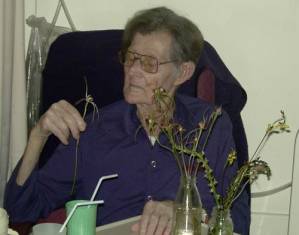
Ron Heberle in hospital shortly
before his death. Still loving his WA native terrestrials.
His interest in natural hybrids and variations within species has been
beautifully recorded in his slides. Ron liked to point out that these slides
only represent a fraction of his experiences with the wonderful WA terrestrial
orchids. Ron and Pauline had recently moved to Perth and joined the Species
Orchid Society of WA. His wish was to make his records available to as many
people as possible and to this end, had invited the society to put samples of his
photography on the Societies Internet site.
Ron's orchid experience came from
field work rather than from any formal education, and as such he had very
little patience with some trained botanists whom he saw as hypothesizing from
ivory towers, and had no compunction in telling them so.
He was very interested in the
natural hybridization of native WA terrestrial orchids and would make them a
focus at the slide shows that he often gave to local orchid Societies in and
around the Perth region. Even at 90 years of age, Ron was still happy to give
these slide shows, and indeed he was due to present one at the Orchid Society
of Western Australia the week he died.
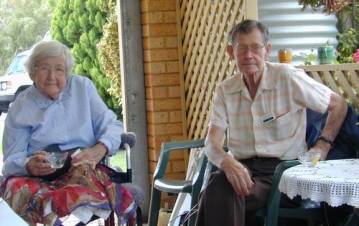
Pauline & Ron Heberle. March
2003
Both Ron and Pauline will be
missed by the orchid community here in WA and everywhere that Western
Australian terrestrial orchids are appreciated.
Reg Allison, at age 56, was in his second year as President of the Society and, like Ron Heberle, was also well respected and loved by all who knew him. Reg was one of those quiet, unassuming people, who manage to get the impossible done without seeming to have tried too hard.
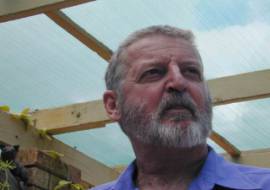
He was a returned serviceman, having served with the Australian SAS contingent during the Vietnam conflict, and later was recruited into the initial Australian Anti Terrorist organization. According to Reg, his health problems stemmed from his training with the later group, when he and other trainees were subjected to a mock gas attack which left them all gasping and coughing for weeks afterward.
Reg seemed to recover eventually,
and after leaving the Army, took up employment in the civilian world. He prided
himself on his fitness and frequently ran marathons just to for the hell of it.
He became interested in caged birds and had quite a large collection of them,
when he collapsed one day with lung problems.
After much hospitalization and
having half of one lung removed, he was advised to get rid of the birds as
their dust and feathers could have been a contributing factor to his health
problems. This he did, and began to increase his interest in orchids. Reg first
came across Australian native orchids when he was training with the SAS in the
Queensland rainforests in which orchids abound. He was often seen scaling trees
to get a closer look at some orchid or other, as his army friends can attest.
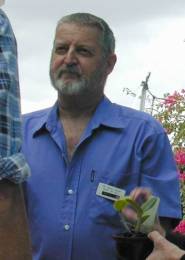
One of the first orchids that Reg
'acquired' was a Dendrobium speciosum, which he still had at the time of
his death. It is one of the biggest plants of this species that most of us have
ever seen and, happily for the plant, Reg's widow, Trish, is to keep this orchid
as a kind of memorial to Reg.
Reg's interest in WA's native
terrestrial orchids was sparked by Ron Heberle and his nephew, Graham Bowden,
the Societies hard working Secretary. The three of them often would travel many
kilometers around the state to look at terrestrial orchids in their natural
surroundings.
Reg was instrumental in organizing
a rescue dig where the Mitchell Freeway is to be extended north of Perth. He
had the tenacity to wend his way through a minefield of bureaucracy that would
have daunted others, to finally get permission to remove the orchids to safety,
a task that was taken up by many members of the Society.
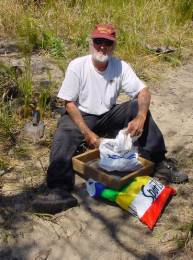
Reg, doing what he loved best.
Saving orchids.
With the passing of Reg Allison
and Ron Heberle, it is up to the members of the Species Orchid Society of
Western Australia continue the work that they have pioneered.
Their loss is deeply felt by all
who knew them.