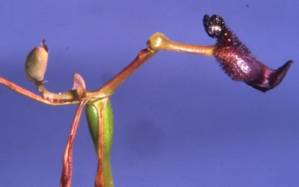
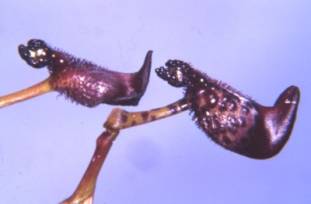
DRAKAEA (Hammer orchids)
Named after Miss Drake, a
botanical artist who drew orchids and other plants to assist taxonomists in
England in the 1800's. This species bears an insectival labellum that is
attached to a stem, which holds it aloft. This has an elastic hinge that can
only be moved backwards where the broadly winged column carries the pollina and
stigma. The elaborate labellum structure is not sensitive and needs
considerable force to be moved. This force is applied be fast flying male wasps
deceived by the resemblance to the flightless females and the orchids
pheromones, which are similar to that which the female gives off when they are
ready to mate. The male grasps what he believes to be a receptive female,
overcomes the resistance of the elastic hinge and is catapulted backwards so
that the back of his head is forced against the column. If he is carrying
pollen, it is transferred to the stigma, or, alternatively, he receives a daub
of pollen attached to his head for transfer to the next orchid he visits. A
truly remarkable mechanism that is highly successful in fertilising the orchid
and perpetuating the species. There are four named species, (Drakaea
elastica, Drakaea glyptodon, Drakaea livida and Drakaea thynniphila.),
five in manuscript awaiting validation under the 'code', and three hybrids. The
species is presumed to have a one to one pollinating strategy where one insect
type (wasp) pollinates one species and no other. However the presence of
hybrids suggests otherwise. Ron Heberle. April 2003
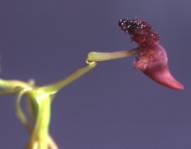
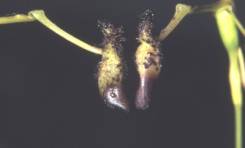
|
Drakaea concolor,
Murchison River, Aug 1980 |
Drakaea confluens,
Dinninup, Nov 1982 |
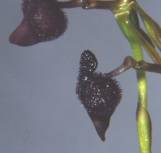
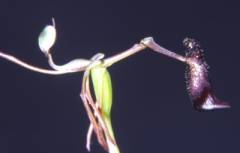
|
Drakaea glyptodon, Bayonet Head, Albany, Sep 1987 |
Drakaea gracilis,
Manjimup, Oct 1985 |
|
Drakaea isolata,
Pingrup, Oct 1992 |
|
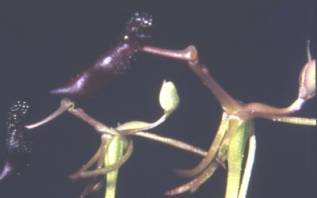
Drakaea isolata, Drakaea
livida, Pingrup, Oct 1992 |
|
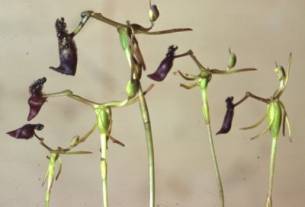
Drakaea micrantha, Drakaea thynniphila, Mt
Barker, Oct 1982 |
|
Drakaea thynniphila, Drakaea
elastica, Drakaea
jeanensis, Drakaea
glyptodon, Bakers
Junction, Albany and Murchison River, Sep 1980 |
DRAKONORCHIS (Dragon orchids)
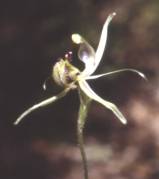
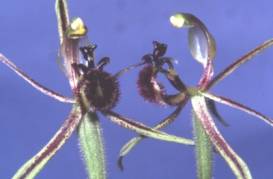
According to Hoffman and Brown (1998), the Dragon orchids were originally placed in Caladenia. Their labella are covered in long hairs, rather than calli and they have short, broad leaves which lie flat on the ground. There are at least 4 species, all confined to West Australia.
|
Drakonorchis barbarella,
Kalbarri, Sep 1988 |
Drakonorchis barbarossa,
Narrogin, Oct 1991 |
|
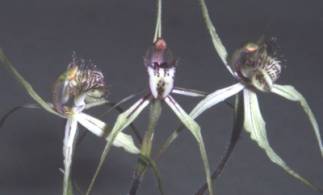
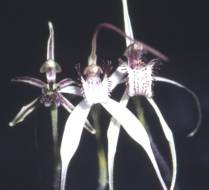
Possible hybrid Drakonorchis barbarossa x Caladenia
eminens,
Pallinup, Sep 1991 |
|
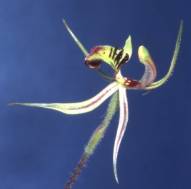
Possible hybrid Drakonorchis barbarossa x Caladenia
falcata, Jerramungup, Oct 1995 |
Possible hybrid Drakonorchis barbarossa x Caladenia
patersonii,
Jerramungup, Sep 1984 |
ELYTHRANTHERA�
(Enamel orchids)
The name Elythranthera is
derived from the Greek 'elutron' and 'anthera' and refers to the column wing,
which acts like a hood over the anther. The two recognized species of
Elythrantheras are easily spotted in the wild by the glossy sheen on the sepals
and petals, which tend to shine and appear to be made of porcelain, hence the
common name of 'Enamel Orchids'. This unusual feature causes Elythrantheras to
be very attractive, when seen in the bush. Elythrantheras are endemic to the
Southwest of Western Australia where they are quite common and widespread.
Fortunately, they are not endangered despite much land clearing in their range,
which is from Kalbarri in the North, to East of Esperance on the South Coast.
They are terrestrial orchids that, after flowering, become dormant during the
hot summer months while the tubers survive below ground. Their growth begins
again with the winter rains and flowering commences during the spring. The
solitary leaf, about 10cm long, appears at the base of the stem. The leaf, stem
and the margins of the petals & sepals, are covered in small, dark hairs. Elythranthera
brunonis, the Purple Enamel Orchid, is usually taller, (to 30cm) than E.
emarginata, (12-15cm) but has a much smaller flower. E. brunonis can
have up to three flowers per stem that are around 2-3cm across. Elythranthera
emarginata, the Pink Enamel Orchid, has flowers up to 5cm across and often
has more flowers per stem than E. brunonis. There are also differences
between the two species, in the way the labellum (lip) bends. Even though Elythranthera
brunonis are purple and E. emarginata are pink, there have been Alba
specimens of both species recorded, and also hybrids between the species. As
mentioned before, the front of the sepals and petals as well as the lip, have
an enamel like finish, the backs, however are quite different. The background
colour on the rear of the flowers is much lighter with dark pink to purple
spots all over. Although both species have much the same range, E.
emarginata can usually be found in wetter areas, and also tend to form
clumps or colonies. E. brunonis on the other hand, can be found in many
different soil types and plants are often found singly.
Tony Watkinson
|
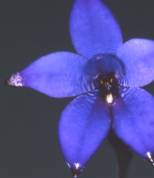
Elythranthera brunonis, Eden,
Oct 1988 |
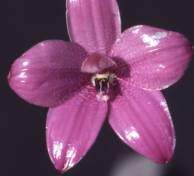
Elythranthera emarginata, Albany,
Nov 1980 |
|
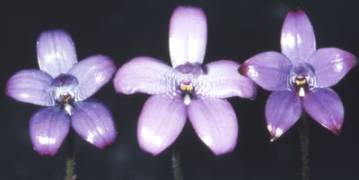
Elythranthera emarginata x Elythranthera
brunonis, Rocky
Gully, Oct 1982 |
EPIBLEMA� (Babe
in the cradle orchid)
Epiblema is a
species with two distinct varieties. They were first recorded by Robert Brown,
a botanist on Mathew Flinders exploration and mapping visit to King Georges
Sound, Albany, Western Australia in December 8th 1801 to January 5th 1802.
Brown, assisted by Ferdinand Bauer (botanical artist) and Peter Good, (Kew
Gardens) recorded some 500 plants, mostly new to botanical science. Thirteen
were orchids, including Epiblema. These collections were named and
described by Brown in Prodromous (1810), the forerunner to The Flora
of New Holland & the Island of Van Dieman. The orchids pictured in this
gallery, are of Epiblema grandiflora variety grandiflora. There is
another variety (var. cyanea) which occurs in only two known areas, one
in a Northern Perth suburb and the other at Walpole on the South Coast.
The variety grandiflora, is
wide spread throughout the coastal strip from Perth to east of Esperance where
the handsome purple flowers grow mainly in swamps covered in thick rushes and
often with their roots in water. It seems that they start their growth while
there is standing water in the swamps, and growth and flowering continues after
the swamps dry out in the summer. After flowering, Epiblema become
deciduous, resuming growth with the winter/spring rains. Epiblema are
terrestrial orchids with subterranean tubers, they have a single leaf, that is
almost terete, to 20cm approximately. The stem grows to about 80cm tall and can
carry up to 8 blue to mauve flowers with darker spots. The flowers are up to
4cm across and have a most unusual series of ribbon like appendages at the base
of the labelum. The column wings form a hood over the anther. The flowers are
very similar to Thelymitras but do not share the Thelymitra habit of
closing on cloudy days and at night. They grow in peaty soils in winter wet
swamps and tend to form colonies. They do not appear to require fire to
regenerate and can be seen flowering between November and January. The other
variety, var. cyanea, has similar growth habits and differs from var.
grandiflorum in being pale blue in colour.
Tony Watkinson
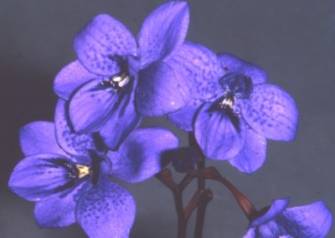
|
Epiblema grandiflorum, Cheyne
Beach, Nov 1991 |
ERIOCHILUS (Woolly lip or Bunny orchids)
This hardy species is an autumn flowerer
regardless of early rain or not. They have been found north to Sharks Bay, east
to Mundrabilla/Eucla and from the south west inland to the perimeters of the
eastern and northern wheat belt. They can flower in thousands, particularly
after a summer burn. There are four species validly named, three currently in
manuscript and a further four sub-species. The last seven have had their names
prematurely released and published in some orchid books bringing them into
common use. They have not been validated under the International Code and care
must be taken when using them.
E. scaber (rough
hairs) or Pink Bunny is quite small but can be super abundant over a wide area.
E. multiflorus (many flowered) is the tallest of the species with many
close packed flowers. E.dilatatus or the White Bunny has its sepals
dilated and can have up to ten flowers.
E. tenuis or the
Slender Bunny Orchid has a later flowering period and is sparsely distributed
throughout the South West. Some of the, as yet, invalidly named species are
shown in this gallery and remarkably one graphically shows a stern mother with
her chastised child who is crying its eyes out and another is from the barnyard
where a proud rooster and a little hen are depicted. These species can be
easily identified by the thin wiry stems and the small leaves which are present
about one third of the way up the stems. Very small native bees pollinate them.
Ron Heberle. April 2003
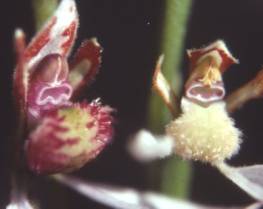
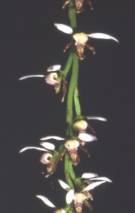
|
Eriochilus dilatatus, Bakers
Junction, Albany, April 1982 |
Eriochilus multiflorus, Bayonet
Head, Albany, May 1987 |
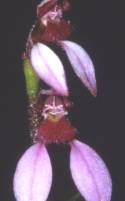
|
Eriochilus scaber,� Bakers Junction, Albany, July 1986 |
GASTRODIA (Potato orchids)
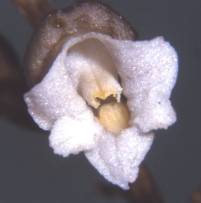
According to Hoffman and Brown
(1998), the genus Gastrodia has at least 25 species, distributed from
India to Malaysia, Indonesia, New Zealand and Australia. Only one species
occurs in West Australia. Gastrodia do not contain green coloration and
have no true leaves.
|
Gastrodia lacista, Torbay,
Nov 1991 |
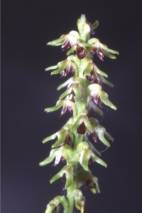
GENOPLESIUM (Pygmy orchids)
This genus consists of over 35 species, two from New Zealand, one from New Caledonia and the remainder from Australia (Hoffman and Brown, 1998). Only one species is found in Western Australia.
|
Genoplesium nigricans, Lake King, May 1993 |
LEPORELLA (Hare orchid)
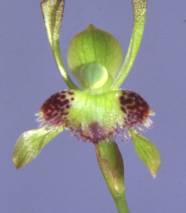
Leporella occurs
only in Australia (Hoffman and Brown, 1998). The range is from Victoria, South
Australia and West Australia. Leporella is latin for hare. There is only
one species, which has previously been included with Leptoceras and Caladenia.
|
Leporella fimbriata, Bakers Junction, Albany, June
1987 |
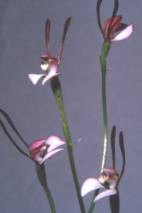
LEPTOCERAS (Rabbit orchid)
Leptoceras is related
to both Caladenia and Leporella (Hoffman and Brown, 1998). Its
only species is found in South Australia, Victoria, New South Wales and
Tasmania.
|
Leptoceras menziesii, Tone River, Sep 1987 |
LYPERANTHUS (Rattle beak orchids)
Until recently, Lyperanthus
consisted of 4 Australian species, two of which have now been placed with Pyrorchis
(Hoffman and Brown, 1998). One species occurs in West Australia. Both species
have a long, narrow leathery leaf and do not require fire to facilitate
flowering.
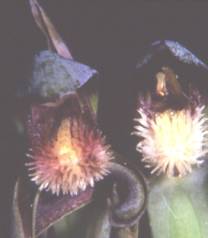
|
Lyperanthus serratus, Spencer
Park, Albany, Oct 1991 |