CALOCHILUS (Beautiful Lip or Beard
orchids)
Calochilus is
widespread throughout Australia with some ten species named. Three of these are
present in the south west of WA. and two others are found in the Kimberley in
the north of the state. The striking bearded labellum is the focal point shown
in the photos. C. robertsonii is common in the lower southwest high
rainfall areas. Its preferred environment is to grow in sandy peat swap
perimeters and in winter wet dried out peat swamps where it can flower with
population explosions after previous summer bush fire. There is an inland
variant recorded from York to Narrogin and south to Highbury. C. campestris
was earlier not thought to be in WA but specimens have been found near Albany
in the South Stirling Range and further east to Hopetoun. Note the sham eyes in
the last two. C. holtyzei and C. aeruleus from the Kimberley region
have been researched by Kingsley Dickson via the Kings Park Research Centre.
This area is difficult to access and there is a likelihood of more new species
being found.
Ron Heberle. April 2003
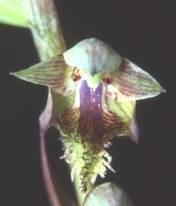
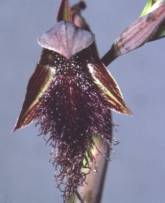
|
Calochilus campestris, South
Stirling, Nov 1983 |
Calochilus robertsonii, Albany,
Nov 1986 |
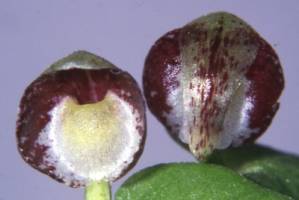
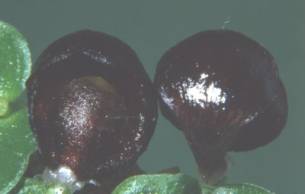
CORYBAS (Helmet orchids)
There are over 20 species of
helmet orchids in Australia, including at least 5 species in West Australia
(Hoffman and Brown, 1998). The genera has over 100 species, including some in
China, Malaysia, Indonesia and New Zealand. In West Australia, helmet orchids
are mainly confined to moist, shaded areas, near the coast.
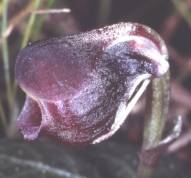
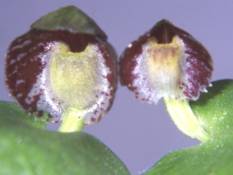
|
Corybas abditus,
Walpole, Oct 1974 |
Corybas despectans, Gull
Rock, Sep 1987 |
|
Corybas limpidus, Gull
Rock, Sep 1987 |
|
Corybas recurvus, Gull
Rock, Aug 1988 |
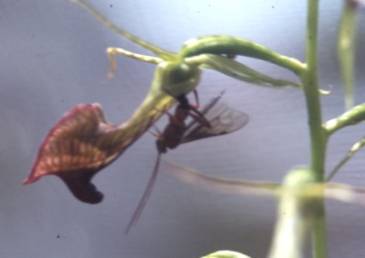
CRYPTOSTYLIS (Slipper orchids)
Cryptostylis is another
of the hardy summer flowering orchids. The genus is present in Malaysia, New
Guinea, Formosa, the Philippines, New Caledonia and numerous Polynesian
Islands. Five species are present in Australia with just one in Western
Australia (Cryptostylis ovata). Its late flowering, the handsome oval
leaf and its persistent habit of surviving from year to year easily recognize
the species. The flower has rudimentary segments with the exception of the
large resupinate labellum with its sexual parts concealed underneath. This
pseudo-copulating orchid demonstrates the one to one pollination or plant
association where the same type of wasp, Australia wide, fertilizes the orchid.
Ron
Heberle April 2003
|
Cryptostylis ovata�and wasp, Dec 1982 |
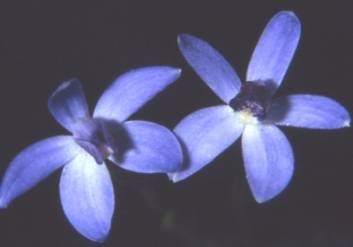
CYANICULA (Blue orchids)
According to Hoffman and Brown
(1998), there are at least 10 species of Cyanicula, all occurring in
West Australia, with two extending to the eastern States. Most were previously
classified as Caladenia. The name refers to the blue flowers
characteristic of this genus. However, one species has yellow flowers.
|
Cyanicula amplexens,
Walgooland, Sep 1987 |
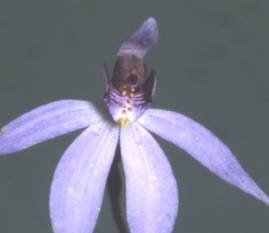
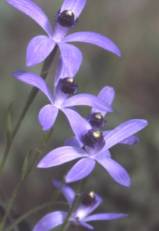
|
Cyanicula caerulea, Boxwood
Hills, Oct 1990 |
Cyanicula deformis, Lort
River, Aug 1980 |
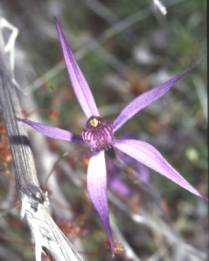
|
Possible hybrid Cyanicula deformis x Caladenia
radialis,
Cunderdin, Sep 1983 |
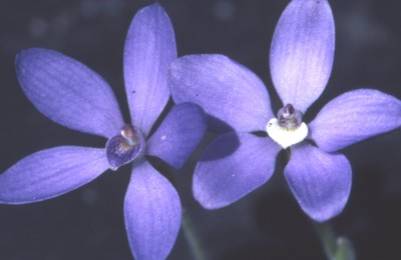 ���������
|
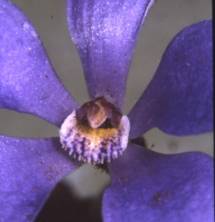
Cyanicula gemmata,
Cranbrook, Sep 1982 |
|
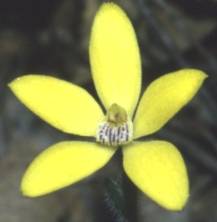
Cyanicula gertrudiae, Mt
Clarence, Albany, Oct 1990 |
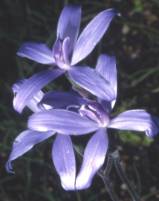
Cyanicula ixioides,
Bindoon, Aug 1987 |
|
Cyanicula sericea, Mt Clarence, Albany, Sep 1995 |
CYRTOSTYLIS (Mosquito orchids)
There are just three named species
in the south west of WA. These have been proved to be present as far north as
Kalbarri and as far east as Israelite Bay. However the major distribution is in
the high rainfall areas of the extreme southwest where these colony forming species
can be abundant. The three species are C. heugelii, C. robusta and C.
tennuissima. There is also an unnamed species from the Tone River.
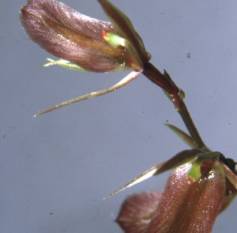
|
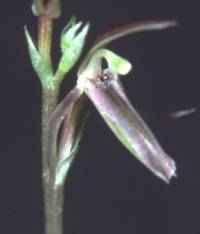
Cyrtostylis huegelii,
Manjimup, Aug 1984 |
Cyrtostylis robusta,
Jerramungup, Aug 1987 |
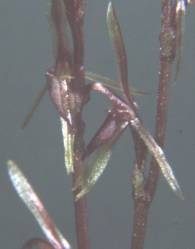
|
Cyrtostylis tenuissima, Lake
Seppings, Albany, Oct 1988 |
�